K.V. Venkateshaiah, K.A.S. Additional Deputy Commissioner, Bengaluru (Rtd) & close Family Relative of Dr. Sarvepalli Radhakrishnan
The Teacher Who Became the Philosopher-President
Born: 5 September 1888 – Demise: 17 April 1975
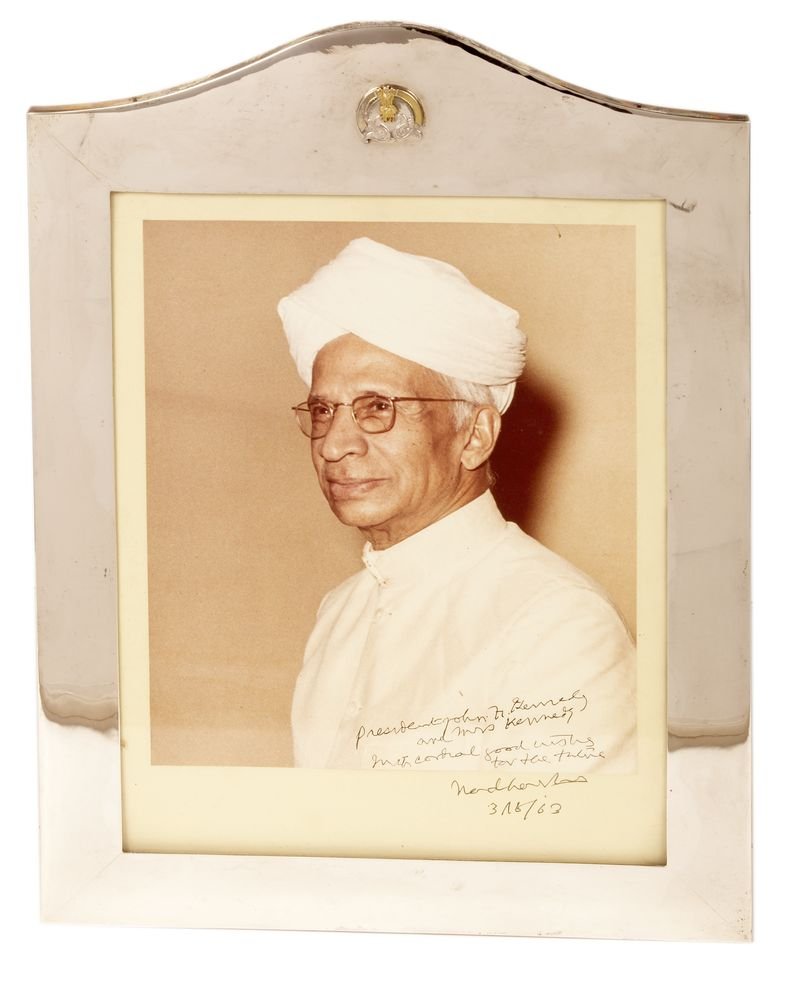
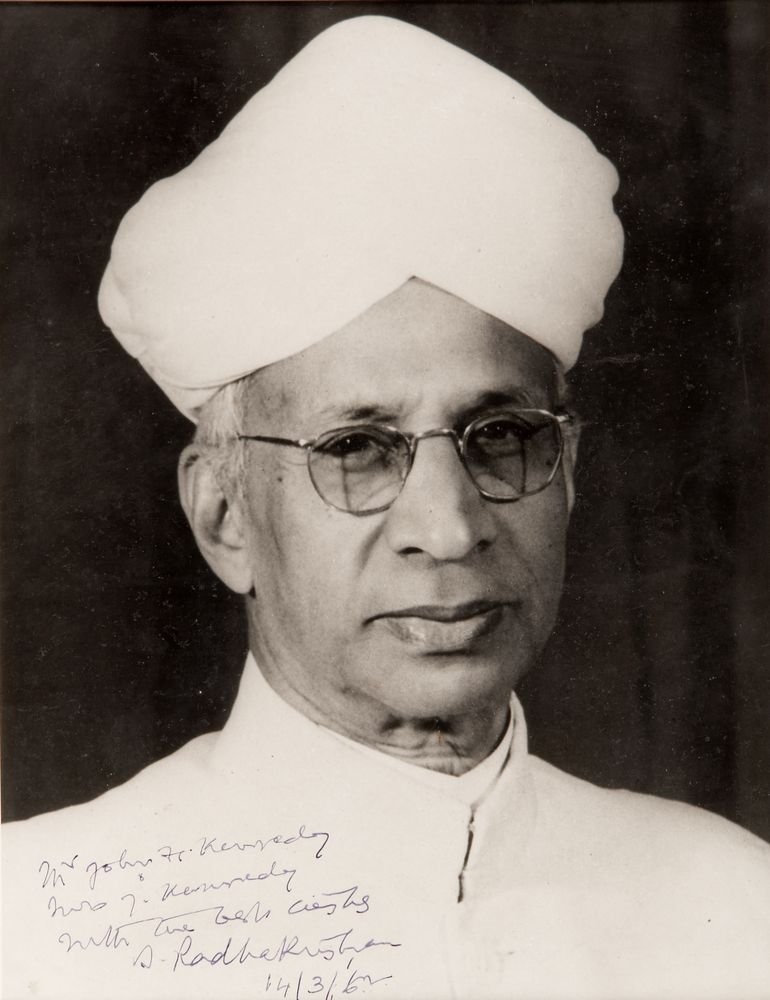
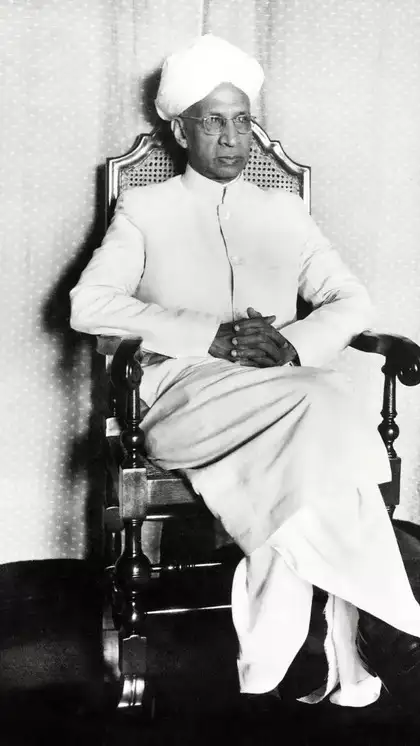
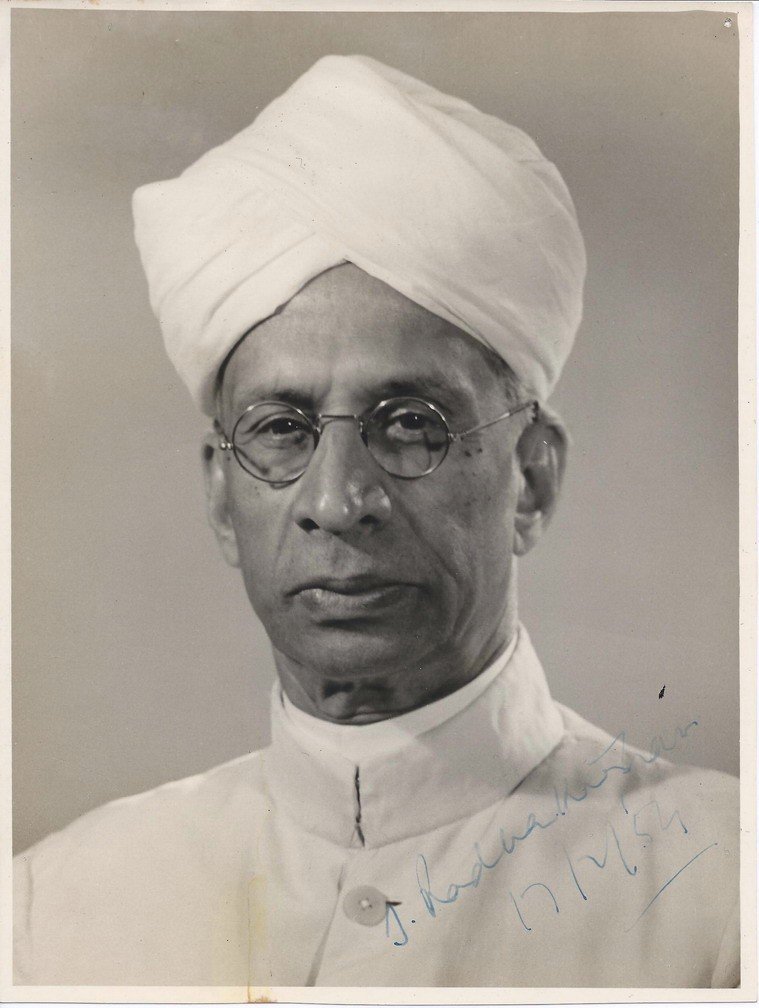
There are lives that belong to a person, and there are lives that gradually become part of a nation’s memory. The life of Dr. Sarvepalli Radhakrishnan belongs to the second kind. Born on 5 September 1888, in a modest Telugu-speaking family, he rose through the power of learning, scholarship, character and public service to become one of India’s most distinguished philosophers, educators and statesmen—and ultimately the second President of India.
His ancestral family traced its roots to Sarvepalli village in present-day Andhra Pradesh, the ancestral village from which the name “Sarvepalli” came into his family identity. His journey is therefore more than a story of personal achievement. It is a story of what education can do to a human being—and what an educated human being can do for a nation. From modest beginnings to the world of ideas Radhakrishnan’s early circumstances were far removed from the grandeur of Rashtrapati Bhavan. His father, Sarvepalli Veeraswami, served as a subordinate revenue official, and the family lived without the privilege or wealth that might have predetermined his future. Yet education opened a different horizon before him. He pursued higher education at Madras Christian College, where philosophy became the great intellectual passion of his life.
He went on to teach philosophy at major Indian institutions, including the University of Mysore and the University of Calcutta. His extraordinary scholarship gradually established him not merely as a teacher of philosophy, but as one of the most important interpreters of Indian philosophical thought to the modern world. His intellectual ambition was remarkable: he sought to demonstrate that Indian philosophy was not merely an ancient inheritance to be admired, but a living intellectual tradition capable of entering into serious dialogue with the great philosophical questions of the modern world. His scholarship brought Indian philosophical traditions into conversation with Western philosophy and comparative religion.
His work helped audiences outside India encounter Indian thought not as an exotic curiosity, but as a sophisticated philosophical tradition worthy of serious study. That journey eventually took him to Oxford University, where he became the Spalding Professor of Eastern Religions and Ethics. Oxford records that he held the chair from 1936 to 1952 and was the first Indian to hold a chair at Oxford as Scholar, teacher and builder of Indian educationFor Radhakrishnan, education was never simply the accumulation of information. He regarded the teacher as a formative force in the life of society—the person who awakens the mind, disciplines thought, develops character and helps a young person discover a larger purpose. His contribution to Indian higher education was therefore both intellectual and institutional. He served as Vice-Chancellor of Andhra University from 1931 to 1936 and later as Vice-Chancellor of Banaras Hindu University from 1939 to 1948.
In 1948, soon after Independence, he was appointed Chairman of the University Education Commission, established to examine Indian university education and recommend reforms suited to the aspirations of a newly independent nation.
The University Grants Commission itself records the importance of this Commission and its recommendations for the future structure of Indian higher education. This was one of the great ironies—and triumphs—of his life: the man who had begun as a student with limited worldly advantages was now helping shape the educational architecture of a newly independent India.
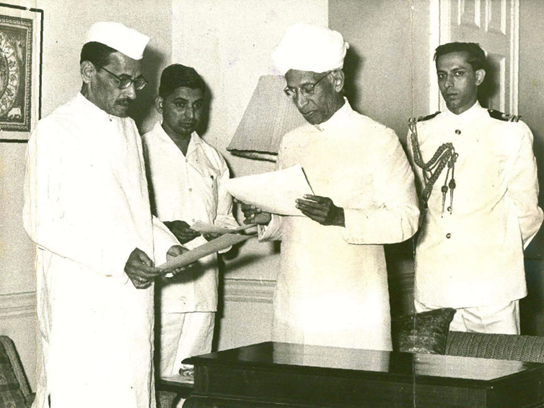
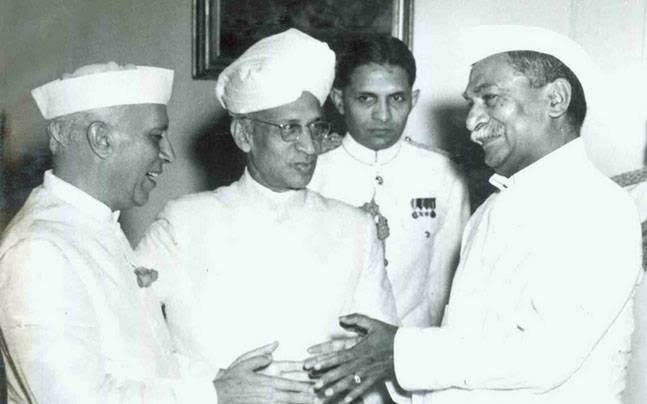
From philosopher to statesman, Radhakrishnan’s public life expanded beyond universities. He served as India’s Ambassador to the Soviet Union from 1949 to 1952, representing a young nation in an intensely divided world. In 1952 he became India’s first Vice-President, serving two terms until 1962. He was then elected the second President of India, serving from 13 May 1962 to 13 May 1967. His ascent from a modest family background to the highest constitutional office was extraordinary. But perhaps what made him distinctive was that he did not abandon the teacher within him when he entered public life.He carried the intellectual discipline of the philosopher into statesmanship, and the humility of the teacher into the highest office of the Republic.
He received the Bharat Ratna in 1954, among many national and international honours, recognising the extraordinary contribution he had made to Indian thought, education and public life. Why September 5 became Teachers’ DayThere is perhaps no more fitting tribute to his philosophy of life than what happened to his birthday. When some of his students and admirers wished to celebrate his birthday, Radhakrishnan is traditionally associated with the suggestion that the day instead be observed in honour of teachers.
Thus 5 September came to be celebrated across India as Teachers’ Day. The tradition transformed a personal birthday into a national expression of gratitude to teachers. It is an extraordinary legacy. The nation does not remember September 5 merely because a President was born on that day. It remembers it because a teacher became so deeply identified with the dignity of teaching that his birthday became a day dedicated to teachers themselves. The President of India’s official profile records that September 5 is celebrated as Teachers’ Day in recognition of his contributions to education and philosophy. The enduring legacy Dr. Sarvepalli Radhakrishnan passed away on 17 April 1975. Yet his intellectual and educational legacy continues. His writings on Indian philosophy, religion, ethics and comparative thought remain part of the intellectual history of modern India. His association with institutions such as Andhra University, Banaras Hindu University and Oxford reflects a life that crossed geographical and intellectual boundaries. His public service connected scholarship with diplomacy, education with nation-building, and philosophy with constitutional responsibility. His life offers India a powerful lesson: Greatness need not begin with privilege.
It can begin with learning. A child from modest circumstances can become a scholar. A scholar can become a teacher. A teacher can shape institutions. An intellectual can serve a nation. And a teacher can ultimately occupy the highest constitutional office of the Republic—without ceasing to be a teacher. That is the journey we remember. That is the legacy we seek to preserve. From Sarvepalli to the world. Sarvepalli is not merely a name attached to a great President. It is the ancestral village associated with the family name of one of India’s most distinguished philosopher-statesmen. A 1963 Government of India Yojana article described Sarvepalli as the ancestral village of President Radhakrishnan and noted its place in his name.
The Radhakrishnan Smarak seeks to bring this heritage into living memory—not as a monument frozen in the past, but as a place where future generations can encounter the journey of a remarkable Indian life. From the village associated with his ancestry to the universities of India and Oxford, from scholarship to diplomacy, from Vice-President to President of India, his journey represents something larger than one individual. It represents the transformative power of education, character, scholarship and service. And that is why his story must continue to be told.
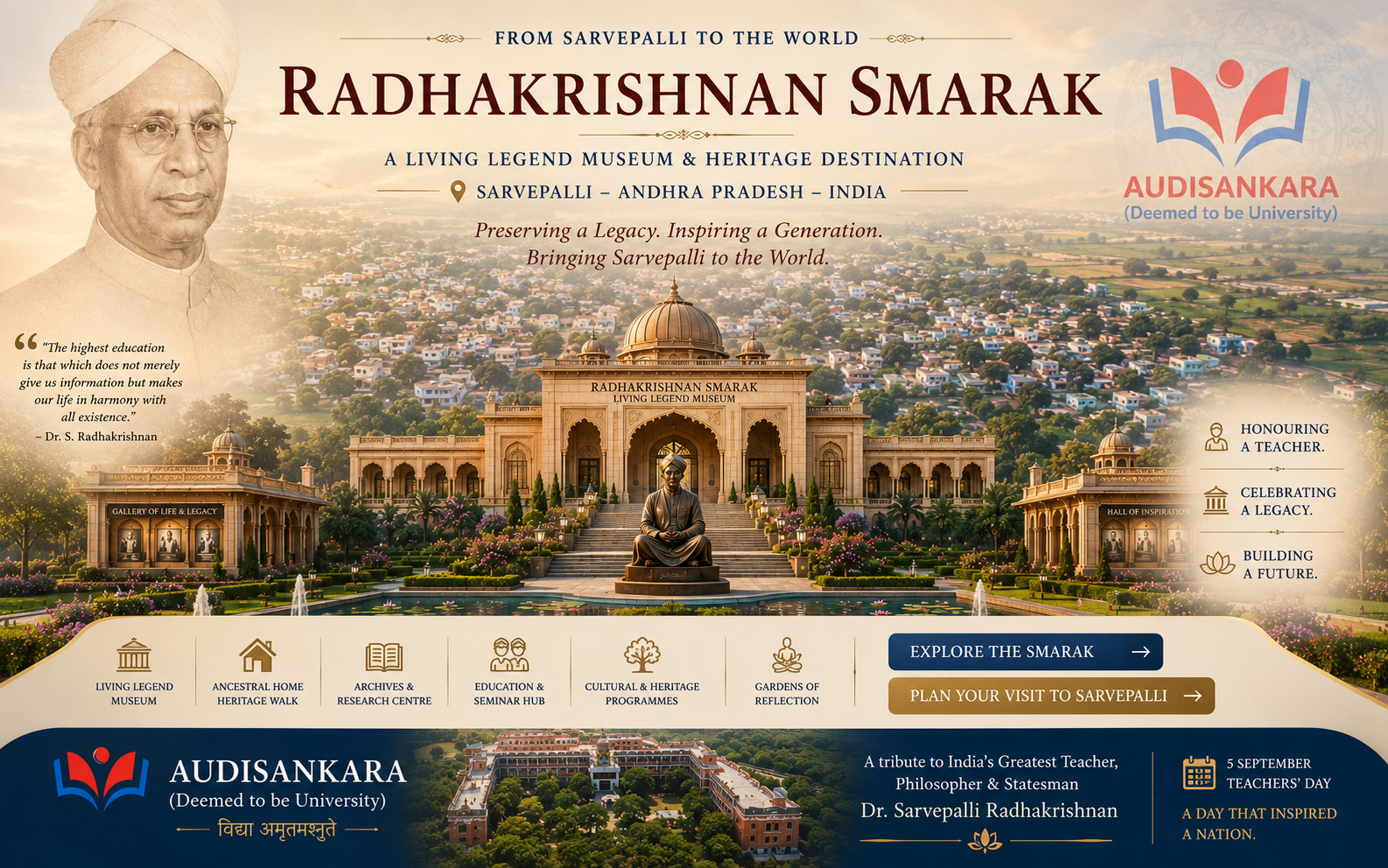
Sarvepalli must not remain merely a name in a history book. It should become a destination of memory, learning and inspiration for India and for the world. WHY THE RADHAKRISHNAN SMARAK? From a Forgotten Village to a Living Place of Inspiration. There are monuments that preserve stone. There are museums that preserve objects. And there are places that preserve memory. The proposed Radhakrishnan Smarak is envisioned as the third kind. On 5 September 2026, on the birth anniversary of Dr. Sarvepalli Radhakrishnan, Audisankara Deemed to be University proposes to declare a five-year initiative to develop and preserve the ancestral village of Sarvepalli and the associated heritage of the Radhakrishnan family as a Living Legend Museum and educational heritage destination.
The purpose is not simply to build another memorial. It is to bring a life back into public memory. Why Sarvepalli? The name Sarvepalli became inseparable from one of India’s greatest philosopher-statesmen.Dr. Radhakrishnan and his family traced its roots to Sarvepalli village in present-day Andhra Pradesh. A Government of India publication from 1963 described Sarvepalli as his ancestral village and explained its connection with the name by which the President became known throughout the world. Yet how many Indians know where Sarvepalli is? How many young students have visited it? How many teachers know that the name of the man whose birthday became India’s Teachers’ Day came from a village in Andhra Pradesh? How many travellers have the opportunity to walk through the landscape associated with his family heritage and understand the extraordinary journey that began there? This is the question behind the Radhakrishnan Smarak. A Living Legend Museum.
We envision a place where history is not merely displayed—it is experienced. The proposed Living Legend Museum would progressively bring together the story of Dr. Radhakrishnan’s life: his family and ancestral roots, childhood and education, philosophical writings, teaching career, university leadership, international intellectual journey, diplomatic service, Vice-Presidency, Presidency, honours and enduring contribution to Indian education. The ancestral home and surrounding heritage landscape would, subject to historical, architectural and legal verification, become part of a carefully curated visitor experience. Students could walk through his story. Teachers could reflect upon his educational philosophy. Researchers could study his intellectual legacy. Families could visit and remember.
Young Indians Gen Z, Gen ALPHA could discover that the highest offices of the Republic can be reached not only through power and privilege, but through learning, scholarship, character and service. Why Audisankara Deemed to be University? Audisankara Deemed to be University is situated in close proximity to Sarvepalli. For us, that geographical relationship carries a responsibility. A university exists not merely to teach students inside its classrooms. It has a responsibility to preserve knowledge, protect heritage, create public understanding and connect education with the society around it. The university therefore sees the Radhakrishnan Smarak as an extension of its own educational mission.
It is particularly meaningful that a university should undertake such an initiative on Teachers’ Day, because September 5 is itself a national tribute to the teaching profession inspired by Dr. Radhakrishnan’s life. The President of India continues to describe him as a great educationist, philosopher and former President and a source of inspiration for the nation. From Memorial to Movement Our ambition is larger than a building. We want Sarvepalli to become a place where education meets heritage. A place where schools can bring children. A place where universities can conduct seminars and research.A place where teachers can gather. A place where travellers can pause. A place where the story of an extraordinary Indian life can be encountered by people from every part of India and, eventually, from across the world. The five-year programme will therefore look beyond the museum itself—to heritage conservation, village development, interpretation, digital documentation, educational tourism, research, cultural programming and responsible visitor infrastructure. The objective is simple:Let the place live. Help us put Sarvepalli on the map Every great heritage destination began as a place that someone decided was worth remembering. We believe Sarvepalli deserves that opportunity. The world knows the name Dr. Sarvepalli Radhakrishnan. Our aspiration is that one day people who know his name will also know the place from which his family heritage came.
Sarvepalli should become a destination for teachers.
A destination for students.
A destination for scholars.
A destination for those who believe in the power of education.
A destination for every Indian who wishes to understand the journey of one of India’s great philosopher-statesman.
We invite you to become part of that journey. Visit. Remember. Learn. Share. Come to Sarvepalli. Walk through its landscape. Discover the story. Bring your students. Bring your family. Tell others. Help us transform a village remembered in history into a Living Heritage of India.
Because preserving the memory of a great teacher is not merely an act of looking backward. It is an investment in the generations yet to come. Radhakrishnan Smarak
Preserving a Legacy. Inspiring a Generation. Bringing Sarvepalli to the World.
STARTING FROM SEPTEMBER 05, 2026, BY ASDU JOIN US IN THIS JOURNEY